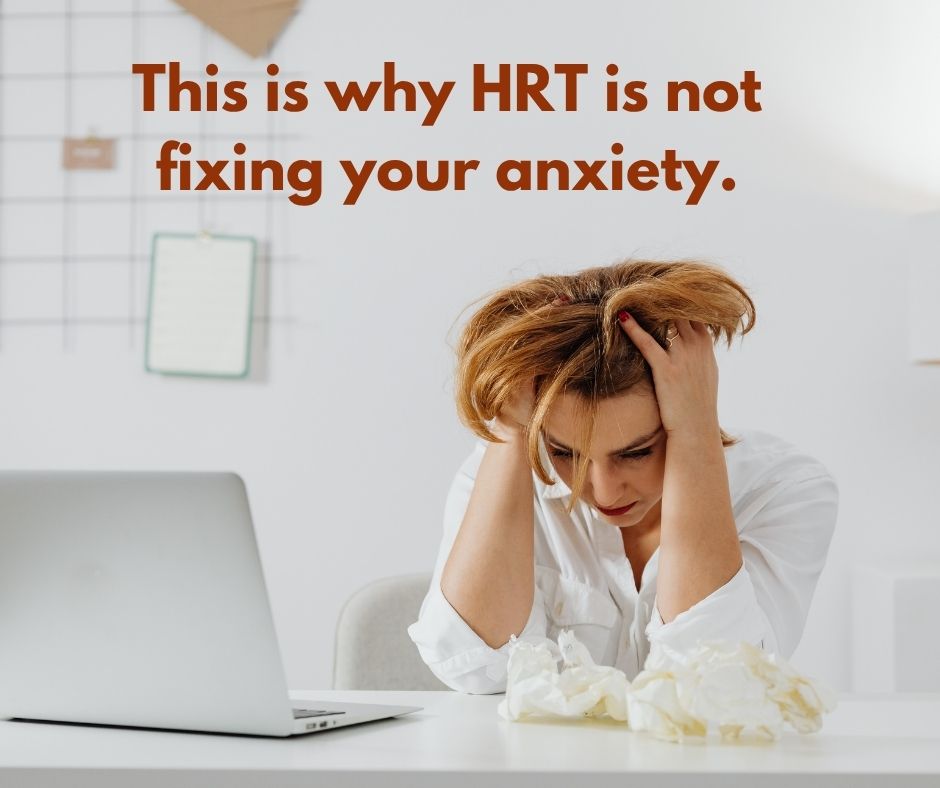
You started Hormone Replacement Therapy (HRT) and some things improved. Hot flushes reduced. Sleep felt more manageable. But the anxiety? Still there. Sometimes worse than before you started.
So you went back to your doctor. They checked your levels. Everything looked fine. Maybe you tried a different dose or a different formulation. The anxiety stayed.
Eventually, quietly, you started to wonder if something was wrong with you specifically. If every other woman was getting better and you were the one failing.
Nothing is wrong with you. What you were told about HRT and menopause anxiety was incomplete. That gap is worth understanding properly.
Can menopause cause anxiety?
Yes. Menopause is one of the most significant physiological transitions a woman experiences, and anxiety is one of its most reported symptoms.
Research from the SWAN study (Study of Women’s Health Across the Nation), which followed over 3,000 women through the menopause transition, confirmed that risk for anxiety increases significantly during this period. Perimenopause, the years before the final period when hormones fluctuate most unpredictably, carries the highest risk for new or worsening anxiety.
But here is where the standard explanation breaks down. Most women are told their anxiety is hormonal and that replacing estrogen will fix it. For many women, it does not. And no one explains why.
Does menopause increase anxiety?
Yes, but not through the mechanism most women are told about.
A 2024 study published in Frontiers in Public Health found that anxiety and mood symptoms in menopausal women were more strongly predicted by sleep disruption, stressful life events, and personal history than by estrogen or FSH levels alone.
Hormonal change is a trigger. It is not the complete explanation. This matters because it means targeting hormones alone will always leave something unaddressed for a significant number of women. If anxiety in menopause had a single hormonal cause, HRT would resolve it consistently. It does not.
Does HRT help with menopause anxiety?
This is the question most women are not given a straight answer to.
The Menopause Society states that hormone therapy “may or may not help” with anxiety symptoms. A systematic review confirms that estrogen-based HRT does not consistently reduce anxiety in midlife women. Where benefits exist, they tend to be indirect: fewer night sweats lead to better sleep, which reduces the overall anxiety burden.
A 2024 survey of women attending specialist menopause clinics found that 39% were able to reduce or stop antidepressant or anxiolytic medication after starting HRT. That is a meaningful result. It also means 61% were not.
If you are in that 61%, you are not an outlier. You are the majority.
Why progesterone matters for menopause anxiety
There is a neurological mechanism that explains why many women feel more anxious in perimenopause even when their estrogen is being managed.
Progesterone converts in the brain to a neurosteroid called allopregnanolone. This binds to GABA-A receptors, the same receptors targeted by anti-anxiety medication, and functions as the brain’s natural calming signal. When progesterone fluctuates erratically in perimenopause and then declines, allopregnanolone drops with it. The brain loses its internal buffer against stress and anxiety.
Research published in the American Journal of Psychiatry links this progesterone-neurosteroid disruption to dysregulation of the HPA axis, the system that governs your cortisol and stress response. It is not just your sex hormones that are affected. Your entire stress management system is destabilised alongside the hormonal shift.
It is also worth knowing that synthetic progestogens used in some HRT formulations do not convert to allopregnanolone the same way that body-identical micronised progesterone does. The type of HRT prescribed matters. But even with the optimal formulation, this addresses one variable in a more complex picture.
What menopause experts say about anxiety and HRT
The 2023 nonhormone therapy position statement from the North American Menopause Society (NAMS) addresses this directly.
NAMS recommends cognitive behavioural therapy alongside or as an alternative to HRT for women experiencing psychological and mood-related symptoms during menopause. This recommendation carries Level I evidence, the highest standard NAMS applies, meaning it is supported by good and consistent scientific research.
The statement explicitly acknowledges that HRT has limitations when it comes to the psychological and emotional impact of the menopause transition. Physical symptoms can be reduced hormonally. The psychological response to those symptoms, and the broader emotional weight that menopause brings, requires a different kind of support. This is not a fringe position. This is the clinical consensus from one of the most authoritative bodies in menopause medicine.
Why so many women start HRT and still feel anxious
Many women who start HRT describe the same sequence of events. The physical symptoms improve. They feel hopeful. Then the anxiety persists, or spikes, and no one has a clear answer for why. Their doctor says the HRT is working. Blood results look normal. But they do not feel normal.
So they conclude the problem is them.
This is one of the most damaging outcomes of under-explaining how menopause anxiety works. Women who should be getting targeted support instead spend months, sometimes years, believing they are the exception. That everyone else got better and they did not. That they are weak, or not trying hard enough, or that their anxiety is something separate from their menopause entirely.
They are not the exception. They were simply not given the full picture. HRT addresses the hormonal layer. It does not, and cannot, address the nervous system dysregulation, the cortisol patterns, the sleep debt accumulated over months of disrupted nights, or the psychological weight that menopause places on a woman’s sense of identity and control. All of those layers need attention. For most women, they never receive it.
The psychological impact of menopause that HRT cannot address
Menopause does not arrive in isolation. It arrives alongside children leaving home, careers peaking or shifting, relationships under new pressure, and a body that no longer behaves predictably. The process of confronting what has changed and what might not return is real, and it is largely invisible in standard menopause care.
The anxiety many women experience is not simply a shortage of estrogen. It is a nervous system under sustained pressure, a stress response that has been dysregulated for months or years, and a psychological experience that has had no outlet.
A review examining mental health care during menopause confirms that psychological and social factors, including perceived stress, prior mental health history, and major life events, are as significant as hormonal factors in determining how a woman experiences the transition.
This is the dimension that I work in. As a menopause trained specialist, I focus on the whole picture. If the physical side of your menopause is being managed but the anxiety remains, that is not a failure. It is a sign that a different layer of support is needed. My Personalised Menopause Management Strategy Session is built specifically for women in this position.
What to take for menopause anxiety
This is one of the most searched questions around menopause, and it deserves an honest answer.
There is no single supplement that resolves menopause anxiety reliably across all women. Magnesium glycinate shows some support for sleep and nervous system regulation. Ashwagandha has emerging evidence for cortisol reduction. Mayo Clinic advises that evidence for herbal supplements in anxiety is mixed and that sourcing and quality control matter significantly. Anxiety UK provides guidance on herbal alternatives reviewed for safety.
BBC Good Food and Holland & Barrett cover natural approaches to managing anxiety that can be useful as supporting tools alongside professional support.
What supplements cannot do is address the nervous system dysregulation, cortisol patterns, sleep debt, and psychological load that drive menopause anxiety at its source. They work best as part of a broader plan, not as the plan itself.
How long does menopause anxiety last?
This depends on what is driving it and whether it is being addressed directly. For women whose anxiety is primarily linked to vasomotor symptoms disrupting sleep, it often improves once those symptoms are managed. For women whose anxiety has deeper drivers, including nervous system dysregulation, accumulated stress, or the psychological weight of the transition, it is likely to persist without more targeted support.
There is no fixed timeline. What research consistently shows is that women who receive support addressing both the physical and psychological dimensions improve more fully and more durably than those receiving hormonal support alone.
Does menopause anxiety go away?
For some women, yes. Once the hormonal volatility of perimenopause stabilises in postmenopause, the physical triggers reduce. Many women report that the transition itself was the most difficult period and that they felt more settled afterwards.
Does anxiety improve after menopause?
It can, but not automatically. Menopause anxiety can remain past menopause. It is more likely to resolve fully when the right support is in place during and after the transition, rather than waiting and hoping it passes. Patterns in how the brain responds to stress require active intervention, not just time.
Menopause anxiety treatment: what to do when HRT is not enough
If you are on HRT and your anxiety persists, you are not failing the treatment. The treatment was never designed to do what you needed it to do.
If you are not on HRT, for any reason, that does not close the door on effective support. My approach works with or without HRT, and with or without any specific health background or diagnosis. What matters is having a clear picture of what is actually driving your anxiety and building a plan around that.
I specialise in supporting women through perimenopause and menopause who are managing the clinical side but not yet feeling themselves. Women who have been told their results are normal and still know something is not right.
If HRT has not resolved your anxiety and you want a clear plan for what to do next, book a discovery call here.
I will take you through what is driving your anxiety, what has and has not been addressed so far, and what a more complete approach looks like for you specifically.